Competition is fierce out there. Selling effectively—and managing your B2B sales funnel (ToFu, MoFu, & BoFu)—requires entirely different tactics today than it did even just a few years ago.
In today’s “internet-fueled” “phone in every pocket” economy, buyer’s have more power than ever before. They also have more demands on their time and attention.
As sales and marketing professionals—it’s our job to distill and tailor information so that it’s relevant to the RIGHT buyer at the RIGHT time.
To be effective in this, we have to have a deep understanding of what drives consumer decisions throughout their journey (ToFu > MoFu > BoFu)—as well as be able to qualify exactly where they are along the buyer’s journey. ONLY AFTER WE DO BOTH—will we be equipped to provide maximum value and nurture a buyer towards the sale.
In this blog, we’ll walk through the stages of the modern buying journey from the standpoint of your sales funnel. In doing this, we’ll frame the individual activities and efforts that will best help you understand and provide relevant information to your leads.
Depending on your organization or offering—your particular sales funnel may be split into any number of custom stages to meet your needs. We understand. Every organization has unique needs and a different approach to sales. But we’ll save the discussion points on specific funnel steps for a later blog.
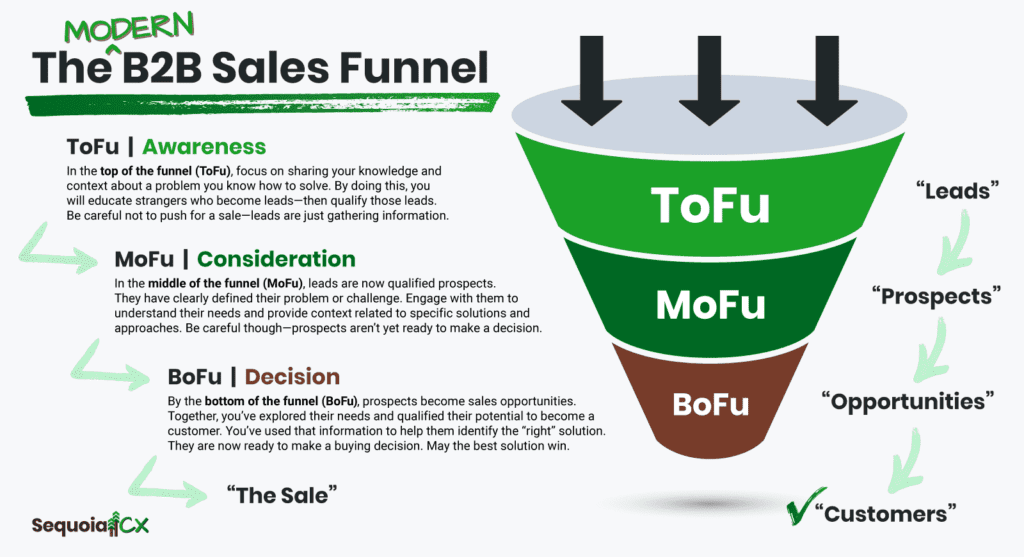
Here we’re going to look at sales funnel fundamentals and how you can best nurture leads through three primary stages: ToFu, MoFu, and BoFu. They’re more than funny acronyms. They provide a powerful framework for driving more sales for your business.
Coming Soon
The top of the funnel, or ToFu, is about attraction and prospecting. As you draw visitors to your site, identify candidates for sales outreach, participate in advertising or social media, or otherwise generate leads—you’re filling the top of the funnel.
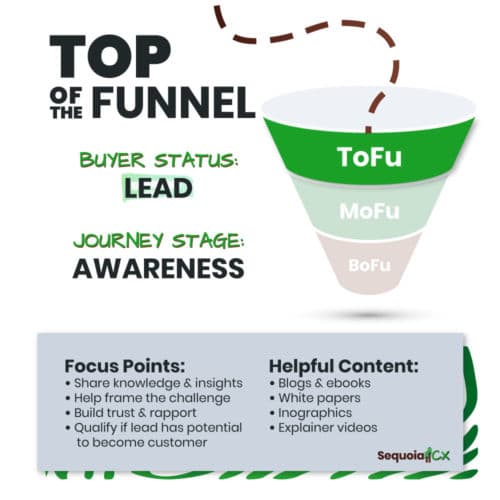
The top of the funnel is where you’ll find most of your leads at any given time.Let’s be honest—likely most of these leads will never purchase from you. And that’s not necessarily a bad thing. Many of them are not even a good fit for your organization.
At this point, the customer knows they have some form of a problem. If they converted on your lead generation website—they likely found you because they were performing research to better understand whatever challenge is in front of them.
While in the ToFu, your efforts should be focused on improving the customer’s “Awareness” of their challenge. If that sounds familiar—you’re right. The ToFu closely relates to the first stage of the buyer’s journey (i.e. 1) Awareness, 2) Consideration, 3) Decision).
Your role in the ToFu should focus on qualification through education. Your role is to help customers improve their understanding of the problem. In doing so, you will foster trust, gain additional insights, and accurately identify if your offerings and organization are a good fit. Try to provide the most relevant information to the individual. Here—you have an amazing opportunity to quickly understand where a lead is along their buying journey and nurture them to become a better prospect.
Remember, modern decision-makers have all of the power and agency in making the best buying decision on their own. As a marketer and salesperson—it’s your job to “help” them get to the point where they make a decision and overcome a challenge.
Focusing only on the transaction and rushing the sale at this stage can be disastrous. In fact, one of the most common mistakes in B2B sales is going into a pitch or progressing the sale too early in the process. This has the potential to alienate leads, progress bad fit clients that should have been filtered out, and even damage your credibility.
Remember—in this stage—you should be carefully identifying each prospect’s needs, their challenges, and the resources they have available to them.
Ask questions, listen, and provide guidance—but avoid being pushy or assertive.
The lead does not yet have a full grasp of their problem—and so likely they’re not ready to consider any specific product or service. Resist the urge to go there.
With these tips you can work towards qualifying (and disqualifying) leads so that you can focus your energy on those that are a “good-fit” and more likely to actually make a purchase.
With an ideal sales funnel and qualification process, you’ll disqualify a good portion of leads before they ever pass beyond the ToFu. For example, you may disqualify leads that:
- Don’t have the budget
- Don’t have the required technical experience on staff to support your product/service
- Use other systems that you don’t integrate well with
- Have a primary need for features that you don’t offer/support
- Don’t have the number of employees or scale to make the investment in your product/service worthwhile
- Are in an industry or niche you don’t have expertise in
Those are some common examples—but, we can discuss qualification in a different blog.
Regarding specific types of content to help you during the ToFu, consider:
- Blog posts and news articles framing problems/solutions
- Research, ebooks, & white papers
Middle Of The Funnel (MoFu)
Once a lead understands—AND—has clearly defined the problem or challenge in front of them—they’ve reached the MoFu, or middle of the funnel.
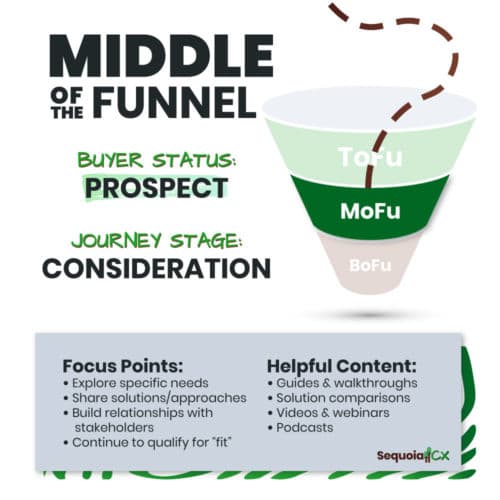
Since we’ve already performed some level of qualification—it’s more applicable to refer to potential buyers that have reached the MoFu as “prospects”.
In this stage, prospects are ready to consider (yes—stage two of the buyer’s journey) specific solutions and approaches. However, they’re NOT YET ready to make any decisions. Also, they’re not yet ready to pick a vendor.
Now in the MoFu—they understand what they’re looking for and are fully invested in research to determine how specific solutions will help them formulate a complete plan to overcome the challenge and achieve more.
Again—be careful not to push the sale at this stage. It’s important that you still focus on building trust and providing support. The prospect is not yet ready to make a buying decision. They are still researching various options, solutions, and approaches. As they continue to gather information—their understanding AND confidence will increase.
The most productive way you can help a prospect move forward and beyond the MoFu is to dive deeper into the specifics of their challenge and objectives. One of the best ways to engage and offer the right level of support is with an exploratory call. During an exploratory call—make it clear that your goal is to better understand the prospect’s needs so that you can provide insights and clarity. You’re not trying to sell anything at this stage.
Here, you’re providing valuable support and context—but you’re also continuing to qualify. In the ToFu, you performed some basic qualifications to identify if a lead met basic requirements to become a customer. Now—in the MoFu—you’ll dive deeper into each prospects’ specific needs and circumstances such as how they’ll use your product or service, their technical competency, future needs, and more.
In the MoFu, you’ll find the following content types to be most effective:
- Guides, Walkthroughs, & Comparisons
- Videos and Webinars
- Podcasts
CAUTION: With any guides or comparisons—be sure you’re comparing solutions rather than individual vendors, product, or service. Remember—within the MoFu, prospects are not ready to make a buying decision… YET.
Bottom Of The Funnel (BoFu)
We’ve reached the bottom of the funnel—or BoFu.
By now—you’ve qualified leads and they’ve become prospects who are all but ready to make a purchasing decision. In the BoFu, we can even consider them opportunities.
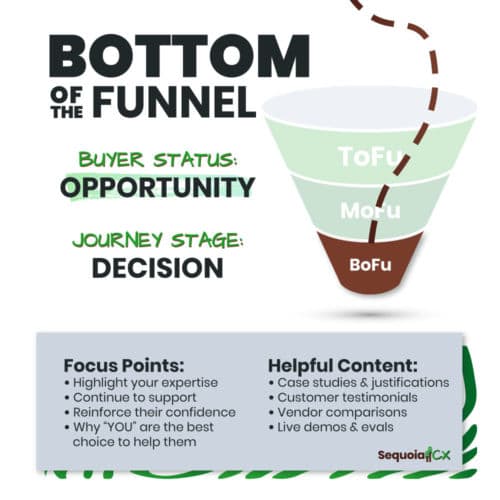
They have a strong understanding of their challenge AS WELL AS the solutions that will help them overcome it. They’ve performed a good deal of research—and likely engaged with a number of other organization’s just like yours during their journey.
Importantly, at this stage, potential customers have the confidence to engage in “sales” and discussions pertaining to a BoFu decision.
At this point, potential customers have likely already formed an opinion about your solution/organization (remember all of those trust-building activities earlier on). Regardless of whether or not you’re the frontrunner—NOW your opportunities are ready and primed to consider specifics and choose a vendor.
In the BoFu, it’s okay to take a “consulting” role and seek to engage more directly. They’re looking for the organization that best fits with their needs and their business.
The most effective forms of content to nurture a decision in the BoFu include:
- Case Studies & Testimonials
- Vendor Comparisons
- Live Demonstrations or Trial Evaluations
How do HubSpot lifecycle stages map to TOFU/MOFU/BOFU?
In HubSpot, Subscriber and Lead sit in the TOFU, MQL and SQL in the MOFU, and Opportunity in the BOFU, with Customer landing past the close. Mapping your lifecycle stages to the funnel is what turns a vague funnel picture into RevOps telemetry you can forecast against—if it's not in the CRM, it didn't happen.
| Funnel stage | HubSpot lifecycle stage | What the contact is | Your nurture goal |
|---|---|---|---|
| TOFU (Awareness) | Subscriber → Lead | A new contact researching a problem | Educate, build awareness, and qualify for fit |
| MOFU (Consideration) | MQL → SQL | A qualified prospect comparing solutions | Build trust, deepen qualification, prove fit |
| BOFU (Decision) | Opportunity | An active deal choosing a vendor | Give proof and a clear path to a decision |
| Post-close (Expansion) | Customer | A won client to retain and grow | Onboard, retain, and expand the relationship |
Treat the mapping as directional, not rigid. The value isn't the labels—it's defining the entry and exit criteria for each stage in HubSpot so your funnel reports the truth and your team forecasts off real signals, not gut feel.
The Modern B2B Sales Funnel In Action (ToFu > MoFu > BoFu)
Let’s bring all of these elements together with an example…
For a moment—imagine that you were just hired on as the head of sales for your organization. You have a handful of dedicated sales reps who’ve been able to produce fairly steady results in the recent past. However, for the past year or so, the organization has been struggling to acquire new business at the same rate.
Management knows that they need to adjust the sales strategy but there’s no specific playbook for this.
So, shortly after you started, you began scrutinizing what little CRM data the company has—as well as performing some online research to map and refine your approach to solving the sale shortage. As you search—you come across B2B Lead Generation Tactics & Examples, a blog that provides a wide range of links and tools.
This blog is incredibly helpful—providing you with several resources and concepts that build upon the preliminary strategy you had already laid out.
Up until this point, you’ve been in the ToFu (Top of Funnel)—learning about the challenge you’re facing and identifying potential solutions.
You determine that the decline in sales your organization has been facing is fairly common—particularly in your industry.
Unfortunately, it seems like your organization is actually facing two challenges. One is related to your sales efforts and engagement—the other with your CRM and data operations.
Now, since you’ve identified the problem you need to overcome and have an idea about the solutions—you’ve transitioned into the MoFu (Middle of Funnel).
This is EXACTLY what you were looking for. So you read the blog.
It provides a framework and step-by-step guide to improving your sales process and engagement numbers. You understand that to reverse the sales trend—you’ll need two concerted efforts:
First, allocate resources and attention towards improving CRM operations. With an improved customer information database, some automation, and better data around deals—you’re confident that you can improve sales.
Second, you’ll need to retool the sales strategy and train the sales representative’s to engage in new ways. They’ll also need some additional collateral—which you’ll need some marketing assistance with.
Now you’re entering the BoFu (Bottom of Funnel).
You know the problem AND how you’re going to solve it. Unfortunately, your organization doesn’t have the resources internally to accomplish everything you want to—so—you begin looking for digital marketing agencies to help execute your plan.
After a bit of searching—you identify several agencies that you think are best-suited to helping you improve your sales process. Ultimately, you reach out and schedule a consultation with each of them. In the BoFu—you’re ready to consider which vendor provides the best solution for you.
Now—you’re ready to make a decision and move forward. At this point, you’re mostly focused on identifying which agency you like best and negotiating project details.
Additional Thoughts On The B2B Sales Funnel
Take a moment to consider the steps in the decision-making process we just walked through. It is nothing like the “car lot” or “time share” experience where you’d expect to be pressured into a sale.
So… As you’re nurturing leads through the B2B sales funnel—remember—be supportive. Provide information and context that’s relevant to each lead based on their current progress along the buyer’s journey.
By following these tips you’ll form stronger relationships, be viewed as a trusted advisor and guide, and—ultimately—generate more sales.
And lastly—take this with you as you venture forth…
You have tremendous power and influence over your customer’s buying experience. Tailor a sales framework for each stage of the funnel and buyer’s journey. Make it easy, low-pressure, and memorable—and you’re sure to find success.
Frequently asked questions about the B2B sales funnel
What's the difference between TOFU, MOFU, and BOFU?
TOFU (top of funnel) is awareness—leads gathering information about a problem. MOFU (middle of funnel) is consideration—qualified prospects comparing solutions. BOFU (bottom of funnel) is decision—opportunities choosing a vendor. Each stage needs different content and a different nurture motion, mapped in HubSpot so your RevOps team can see where every lead actually sits.
How long should a lead stay in the MOFU?
There's no fixed timer—MOFU length depends on deal size, buying-committee complexity, and how fast a prospect gathers the information they need. Instead of guessing, gate progression on behavior and fit signals tracked in HubSpot. A lead stalling in MOFU with no engagement is a telemetry signal to re-nurture or disqualify, not a reason to wait.
What HubSpot lifecycle stages match TOFU/MOFU/BOFU?
Roughly: Subscriber and Lead map to TOFU, MQL and SQL to MOFU, and Opportunity to BOFU, with Customer sitting past the close. Mapping your HubSpot lifecycle stages to the funnel is what turns a vague funnel picture into RevOps telemetry you can forecast against. If it's not in the CRM, it didn't happen.
What content converts best in the BOFU?
BOFU buyers want proof, not education—case studies, testimonials, vendor comparisons, ROI math, and live demos or trials. They've already done their research and are choosing between options, so give them the evidence to pick you and a clear path to a decision.
How do you know when to move a lead from MOFU to BOFU?
Move a lead to BOFU when they show decision intent—requesting pricing, demos, or references, looping in the buying committee, and crossing your fit-and-engagement scoring threshold in HubSpot. The cleanest trigger is a documented score plus a real buying signal, not a rep's gut feel.
Book a RevOps Assessment with Squad4
Most B2B teams don't have a funnel problem—they have a telemetry problem. Leads stall, handoffs leak, and no one can see where in TOFU, MOFU, or BOFU the pipeline is actually breaking. We can spot it in 30 minutes.
Ready to turn your funnel into telemetry? Book a RevOps Assessment with Squad4—we'll map your TOFU/MOFU/BOFU motion to HubSpot lifecycle stages and show you exactly where nurture is leaking before it costs you another quarter.
